Security. Sovereignty. Performance.
Why Trafficmind?
Engineered and operated under Swiss jurisdiction, Trafficmind provides a sovereign edge platform for B2B operators, regulated organizations, and partner-led ecosystems. DDoS protection, WAF, CDN, and telemetry are delivered through a deterministic, policy-controlled infrastructure layer built for performance-critical environments.


Your Strategic Edge with Trafficmind
Swiss legal sovereignty, proprietary edge infrastructure, and hands-on engineering support are combined into a single platform designed for regulated, performance-critical environments.
Swiss Legal Framework
Customer data cannot be disclosed through informal administrative channels or electronic requests. Disclosure is permitted only through Swiss legal process with judicial authorization.
Neutral Jurisdiction
Switzerland is not subject to EU or US extraterritorial disclosure regimes, so cross-border data requests must proceed through formal mutual legal assistance procedures.
Compliance-Ready
Certified and audited controls support GDPR-aligned data handling, PCI DSS-compatible infrastructure, and ISO 27001-aligned operational governance.
Technical Sovereignty at the Edge
Policies are enforced according to explicit rules and routing logic. Traffic data is not used for advertising, profiling, or behavioral monetization, and is not shared with third parties for those purposes.
Proprietary Architecture
Trafficmind runs on a purpose-built edge runtime engineered for high-performance traffic processing, giving the platform tighter execution control, lower overhead, and more predictable behavior under load.
Direct Expert Support
Experienced security engineers provide round-the-clock support, combining edge architecture knowledge with hands-on mitigation and production operations expertise.
Compliance by Design
Compliance is built into the platform architecture from the ground up. Jurisdiction, data handling, logging structures, and operational controls are designed to support regulated environments and structured governance requirements.
Swiss GDPR
Processing is structured around GDPR principles including data minimization, purpose limitation, lawful basis records, and support for data subject rights.
PCI DSS
Encrypted data in transit, segmented networks, controlled access policies, and verifiable log retention help support PCI DSS-aligned environments.
SOC 2 Type II
Documented, auditable controls support SOC 2 assurance reporting for service integrity and financial control alignment.
ISO/IEC 27001
ISO/IEC 27001-aligned controls govern platform operations, including risk assessment, access control, incident response, and continuous improvement.
Swiss Jurisdiction & Legal Sovereignty
Edge-based DDoS mitigation and WAF filtering require traffic termination and inspection. Once encrypted traffic is processed, legal jurisdiction directly governs how data may be handled. This makes the governing legal framework operationally significant.
Operations are governed exclusively by Swiss federal law, including the nFADP and the Swiss Criminal Procedure Code. Customer data cannot be disclosed through informal or administrative requests. Any lawful disclosure must take place within formal Swiss legal proceedings, initiated by competent authorities and subject to judicial oversight and proportionality standards.
Foreign demands carry no automatic legal force outside formal Swiss mutual legal assistance procedures.
Predictably High Performance
Deterministic Edge Architecture
Built in Golang with statically compiled binaries, Trafficmind’s edge runtime delivers deterministic execution and low overhead.
Predictable memory behavior and native concurrency reduce latency, while security logic embedded in the compiled pipeline removes scripting from the critical path.

Integrated CDN & Storage
Progressive caching and optional full replication keep assets hot across edge nodes. Native storage synchronizes files in real time using rsync, with granular file and node-level visibility.
This eliminates cold starts, shields origins during demand spikes, and preserves predictable performance under load.
Collaborative Environment
Layer-Separated DDoS Protection
Trafficmind separates detection from enforcement.
Layer 7 Protection
At Layer 7, behavioral modeling and machine learning leverage ClickHouse to process high-cardinality traffic signals in real time.
Layer 4 Protection
At Layer 4, malicious packets are filtered at the header level before entering kernel or user space.
Incoming traffic

Traffic from
Traffic originating from legitimate users, automated services, IoT devices, and potential malicious sources.
Border Router

L3 filtering
Route validation, fragment filtering, and packet sanity checks block malformed or suspicious network traffic early
Secure Router

L3 and L4
Rate-limit enforcement and flood protection mitigate volumetric attacks targeting transport protocols
NGFW

L4 and L7
Traffic inspection engines apply reputation feeds, behavioral analysis, and threat intelligence policies
Security Appliance

L7 Filtering
Application-layer protection enforces WAF rules, API security policies, and OWASP-aligned controls

Clean Traffic
Validated traffic is securely forwarded to the customer’s infrastructure and services.
Real-Time Telemetry &
Log Ownership
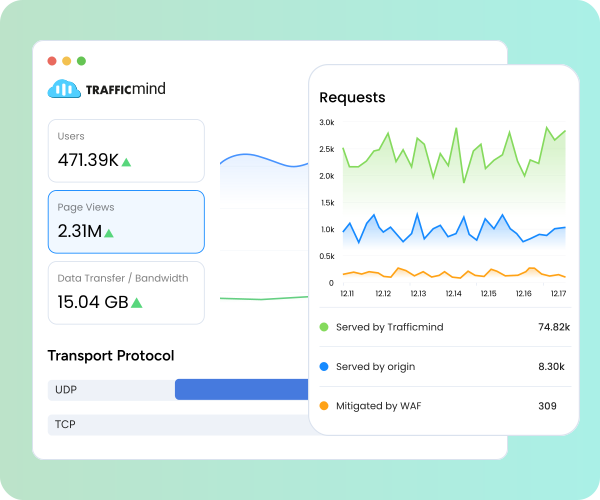
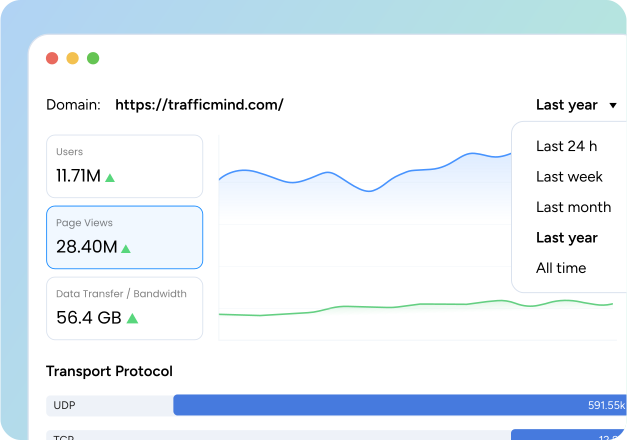
Trafficmind leverages ClickHouse as its analytics engine, processing millions of events per second with near-real-time aggregation and deep historical analysis.
- Full log export functionality
- Live telemetry streams
- Configurable sampling logic
- Customer-owned data access
More than Just Attack Mitigation
Trafficmind security controls extend beyond attack filtering to preserve service continuity, maintain session integrity, and strengthen operational visibility.
Service Continuity
Anycast routing helps reduce congestion and outage exposure, while edge caching lowers latency and offloads compute and bandwidth from origin infrastructure.
Continuous Protection
DDoS activity is detected within 3 seconds and mitigated across global PoPs with up to 3.2 Tbps of edge capacity.
Governance-Ready Controls
Fine-grained controls and transparent reporting help simplify data sovereignty, audit readiness, and regulatory alignment.
Enterprise-Aligned Infrastructure Model
Capacity planning, bandwidth allocation, and platform scaling follow contracted enterprise demand. Trafficmind maintains granular control over load conditions to deliver predictable performance and stronger service consistency for business-critical environments.

Enterprise-Optimized Network
Built for enterprise-grade commercial workloads, the network combines direct tier-1 carrier links and neutral exchange connectivity across major North American and European hubs. Trafficmind ensures predictable latency, disciplined traffic delivery, and controlled operating conditions for protected enterprise services. Capacity is managed to preserve performance consistency for customer-facing applications, APIs, and business-critical environments.
Engineering-Driven Integration
Integration is designed to fit directly into SDLC workflows. Protection logic can adapt to application behavior, WAF rules can align with API schemas, and traffic models can be refined around customer-specific patterns. Close engineering collaboration supports iterative policy improvement across release cycles so security evolves with the application.
Partner-First Commercial Architecture
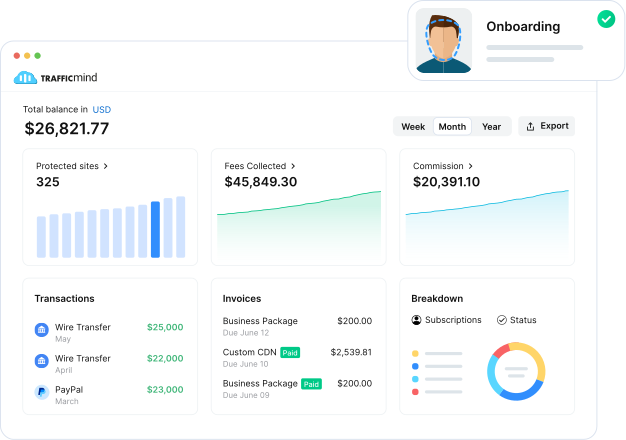
Designed for B2B2B deployment, flexible integration models allow partners to retain margin control, preserve client relationship ownership, and choose the operating model that best fits their commercial structure.
Web Developer Model
End customers are billed directly, while partner commissions are settled on a recurring basis.
Agency Model
The agency manages billing and client relationships while paying for underlying platform usage.
Service Provider Model
Supports branded deployments, compliance-ready environments, advanced integrations, and structured revenue models.
White Label Infrastructure Model
Provides full white-label deployment with dedicated DNS and control plane. Partners retain pricing control and client ownership, while core infrastructure delivery remains centrally managed.
Built for the B2B Infrastructure Marketplace
Designed for integration into established ecosystems, the platform operates as a controllable infrastructure layer that partners can extend, commercialize, and incorporate into broader service offerings. It is built for:
- Managed Security Service Providers (MSSPs)
- Hosting providers
- Compliance auditors
- SaaS infrastructure operators
- White-label platform providers
- Enterprise organizations